Sigillata wurde in mehreren Produktionszentren für römisches Tafelgeschirr in Tunesien hergestellt. Eine dieser Töpfereien befand sich in Henchir el Guellal bei Djilma (Zentraltunesien), wo seit dem frühen 3. Jahrhundert bis ca. 430/450 qualitativ hochwertige glatte, appliken- und stempelverzierte Sigillata sowie typologisch vielgestaltige Lampen gefertigt wurden. Dabei war insbesondere die Sigillata im gesamten Mittelmeerraum weit verbreitet. Im vorliegenden Band werden beide Gattungen anhand von Survey- und Ausgrabungsmaterial bearbeitet und chemisch untersucht, das Lampenrepertoire durch Bestände in Museen und Sammlungen ergänzt und mit dem Repertoire des nahe gelegenen Töpfereizentrums Sidi Marzouk Tounsi verglichen.
The Roman production centre for African red slip ware (= ARS) and lamps at Henchir el Guellal near Djilma is located approx. 130 km southwest of Hadrumetum/Sousse in the interior of central Tunisia. It was one of the major rural pottery centres, producing not only for the regional market but also for sea-based long-distance trade, with its products distributed in most of the Mediterranean. The previously little-known range of products is assessed on the basis of finds from two surveys (1984/85, 1991). There have been no excavations in the area of the mid Imperial/late Antique ARS and lamp potteries. The present investigation therefore focuses on the typochronological and archaeometric analysis of the available fine wares. With the help of a chemical reference group specific to Djilma and additional pXRF measurements, ARS vessels with appliqué decoration or stamped decoration and lamps from other findspots or without a recorded findspot could be reassigned to the production range of Djilma. The aim was to reconstruct as far as possible the repertoire of forms of the ARS vessels and lamps produced from around AD 220/230 onwards. While the plain standard forms of ARS tableware from the 3rd to early 5th century, decorated with pottery-specific stamp-types from the middle of the 4th century onwards, were produced at Djilma, such forms are missing from the middle of the 5th century onwards. This applies accordingly to stamp-types with Christograms and cross monograms, which became increasingly popular from 430/440 onwards, a phenomenon that has been observed in other ARS potteries in northern and central Tunisia.
A new, differentiated typology (HGD I A–VII A5) has been developed for ARS lamps, replacing the previous classifications. Noteworthy is the adoption of figurative appliqués from the pottery centre of Sidi Marzouk Tounsi, 40 km away, which were incorporated as decorative motifs on the discus of lamps made at Djilma. However, discus decorative motifs bearing Christian symbols were not used there in the second quarter of the 5th century, and a dominant lamp type (Atlante X A1a) from the pottery centre of Sidi Marzouk Tounsi was not imitated. It is possible that, due to a lack of innovation in ARS pottery, i.e. new shapes and stamped decorations, as well as in lamps, Djilma was no longer able to meet the demand for high-quality fine wares in the province of Byzacena, or in neighbouring provinces and beyond. It is uncertain whether the political changes of the 430s and the stabilising Vandal rule with the capture of Carthage (AD 439) and the entire province of Africa Proconsularis had a direct impact on large handicraft workshops such as pottery production centres. It is noteworthy that in Byzacena, following the peace treaty concluded between the Vandal king Geiserich and the Roman emperor Valentinian III in AD 442, the pottery centre of Sidi Marzouk Tounsi continued to function, whereas ARS and lamp production in Djilma must have come to an end around AD 430/440 or the middle of the 5th century.
Michael Mackensen (*1949) studied Archaeology of the Roman Provinces, Prehistory and Ancient History at Munich, Freiburg and Oxford from 1969 until 1977. After his MA (1974), PhD (1977) and a travel scholarship granted by the German Archaeological Institute/DAI (1977/78) he participated in excavations of the DAI at Carthage (Tunisia) and Resafa (Syria). From 1982 to 1994 he was research assistant at the Bavarian Academy of Sciences conducting excavations in Bavaria (e. g. Nersingen, Kellmünz) and a survey project at El Mahrine (Tunisia). In 1991 he submitted his habilitation thesis and then became Professor for Archaeology of the Roman Provinces at the Ludwig-Maximilians University of Munich in 1994. He carried out various field projects in Bavaria (2001–2007 Burghöfe), Tunisia (1998/99 Chemtou), Egypt (2001/02 Deir el-Bakhît; 2005–2017 Nag al-Hagar) and Libya (2009/10 Gheriat el-Garbia, LMUexcellent-Project limes Tripolitanus). In 1989 he was allocated with the Kurt-Bittel-Preis für Süddeutsche Altertumskunde, in 2010 with the Preis für gute Lehre des Freistaats Bayern and in 2013 with the LMU Lehrinnovationspreis. In March 2015 he was retired..
https://www.vfp-archaeologie.uni-muenchen.de/personen/ir/mackensen/index.html

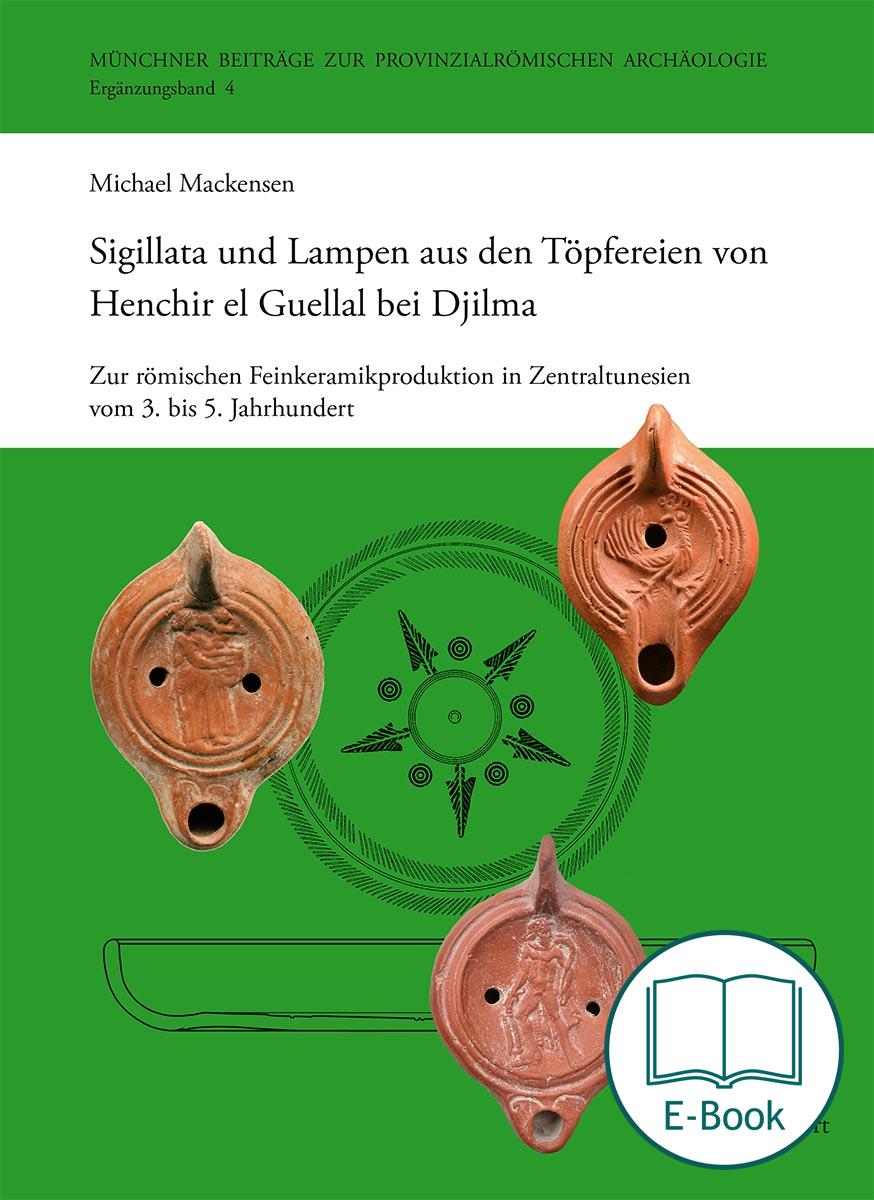
 Table of Contents