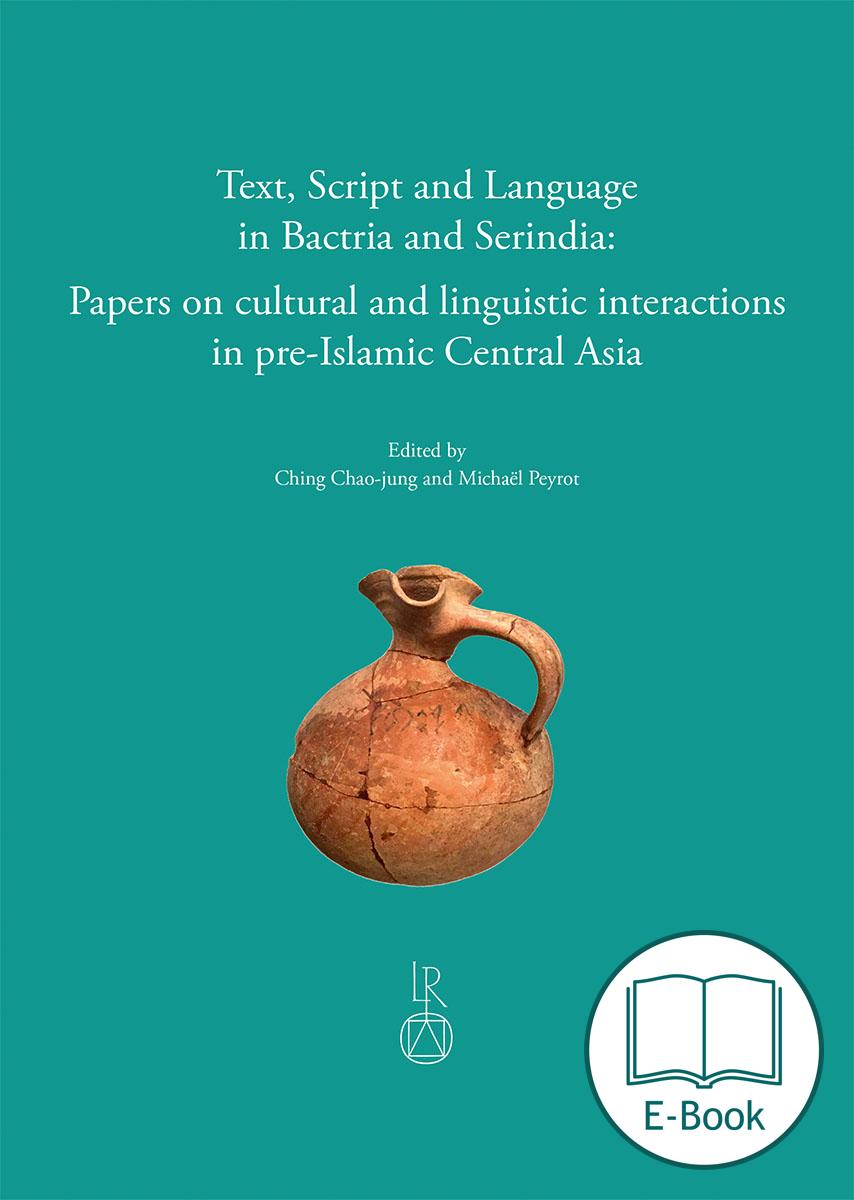
This collective volume unites ten papers by international specialists in history, philology, linguistics, palaeography and archaeology, dealing with texts written in Bactrian, Khotanese, Tumshuqese, Tocharian, and Gāndhārī (Niya-Prakrit) from Afghanistan, Uzbekistan, Pakistan and Northwest China, as well as with classical Chinese Buddhist scriptures and the newly discovered Almosi inscriptions of Tajikistan. With studies of the Kharoṣṭhī, Brāhmī, Graeco-Bactrian scripts and the “unknown Kushan script”, the book presents important advances in longstanding problems of Central Asian philology. The volume will be of interest to scholars and students working on cultural and linguistic interactions in Kushan and post-Kushan times.
The book is addressed primarily to a scholarly audience. It unites ten articles on history, palaeography and linguistics in Central Asia. Ching Chao-jung discusses the translation procedure of Buddhist Sanskrit texts into Chinese and the consequences this has for the interpretation of the geographical terms Bactria and Tukharistan. Alessandro Del Tomba makes an edition and comparative study of the Khotanese and Sanskrit Mahāvaidehaghr̥ta, a medical text that is very difficult to interpret. The Sanskrit text is very corrupt and a detailed analysis and reconstruction are made. Federico Dragoni studies the origin and development of the so-called subscript hook of Khotanese Brāhmī, which is a genuinely Khotanese addition to the Brāhmī script that was originally designed for Sanskrit. Pavel B. Lurje discusses the history of the decipherment of the “unknown script” of Bactria, with important additions and corrections. Francesca Michetti studies the origin on Bactrian final -o by looking systematically at the oldest Bactrian outcomes of Old Iranian endings. Miyamoto Ryoichi studies the gods Wakhsh and Rām-sēt in Bactrian documents. Ogihara Hirotoshi gives a re-analysis of the ownership clause in Tumshuqese sale contracts, which are very difficult to decipher, and where each new reading and interpretation changes our understanding of the poorly attested Tumshuqese language. Michaël Peyrot investigates the Brāhmī diacritic ä, which is found in Tocharian and Khotanese, and constitutes an addition in these two varieties of Brāhmī compared to the original Brāhmī variants for Sanskrit. Niels Schoubben discusses three cases of loanwords between Gāndhārī and Eastern Middle Iranian and offers an annotated translation of a Gāndhārī sale contract written on silk. Nicholas Sims-Williams makes a new edition of the Bactrian inscription of Ayrtam.
Ching Chao-jung is program-specific associate professor at the Kyoto University. After her doctoral study in history and philology at the École Pratique des Hautes Études (2005–2010), she became a postdoc at Peking University (2010–2012) and then a Marie Curie Fellow at the Berlin-Brandenburgischen Akademie der Wissenschaften (2013–2014). She has published Tocharian secular documents and history of ancient Kucha (2017, Peking University Press; in Chinese). In 2021, she and her colleagues were prized for their collective report Qiuci shiku tiji (Cave Inscriptions in Ancient Kucha) with the “Prix Ikuo Hirayma” by the Académie des Inscriptions et Belles Lettres. From 2021 to 2024, she assisted the seminars on the history and cultures of pre-Islamic Central Asia at the Collège de France. Her current research project at the Hakubi Center for Advanced Research, Kyoto University focuses on the oasis societies and writing cultures of the Tarim Basin before the 9th century CE. (
https://www.hakubi.kyoto-u.ac.jp/en/mem/ching/)
Peyrot
Michaël Peyrot (PhD 2010, Leiden University) is professor of Comparative Indo-European Linguistics at the Leiden University Centre for Linguistics. His research focuses on the reconstruction of the verbal system of Proto-Indo-European, and on language contact and prehistory, especially in the Tocharian, Iranian and Indic branches of Indo-European. He has investigated the chronology of Tocharian B, the language of Kucha, in Variation and change in Tocharian B (2008, Rodopi), and in several articles published subsequently. He has also edited the Tocharian fragments of the British Library Collection for the International Dunhuang Project, contributed to A Comprehensive Edition of Tocharian Texts (Vienna), and published editions of Tocharian fragments, and of Tocharian glosses and colophons in Sanskrit manuscripts. (
https://www.universiteitleiden.nl/en/staffmembers/michael-peyrot)
The series Beiträge zur Iranistik was founded in the 1960s by Georges Redard and subsequently edited by Nicholas Sims-Williams from 1997 to 2020; the present series editor is Agnes Korn.
The series publishes works on the languages of the Iranian branch of Indo-European. The focus is on linguistics, including grammars, dictionaries, text editions, philology as well as diachronic and synchronic studies of linguistic topics. Neighbouring fields such as literature, archaeology and anthropology are likewise represented. The languages of the series are English, German and French. The Beiträge zur Iranistik are represented in libraries internationally and are widely used standard works of Iranian studies.
 Preface