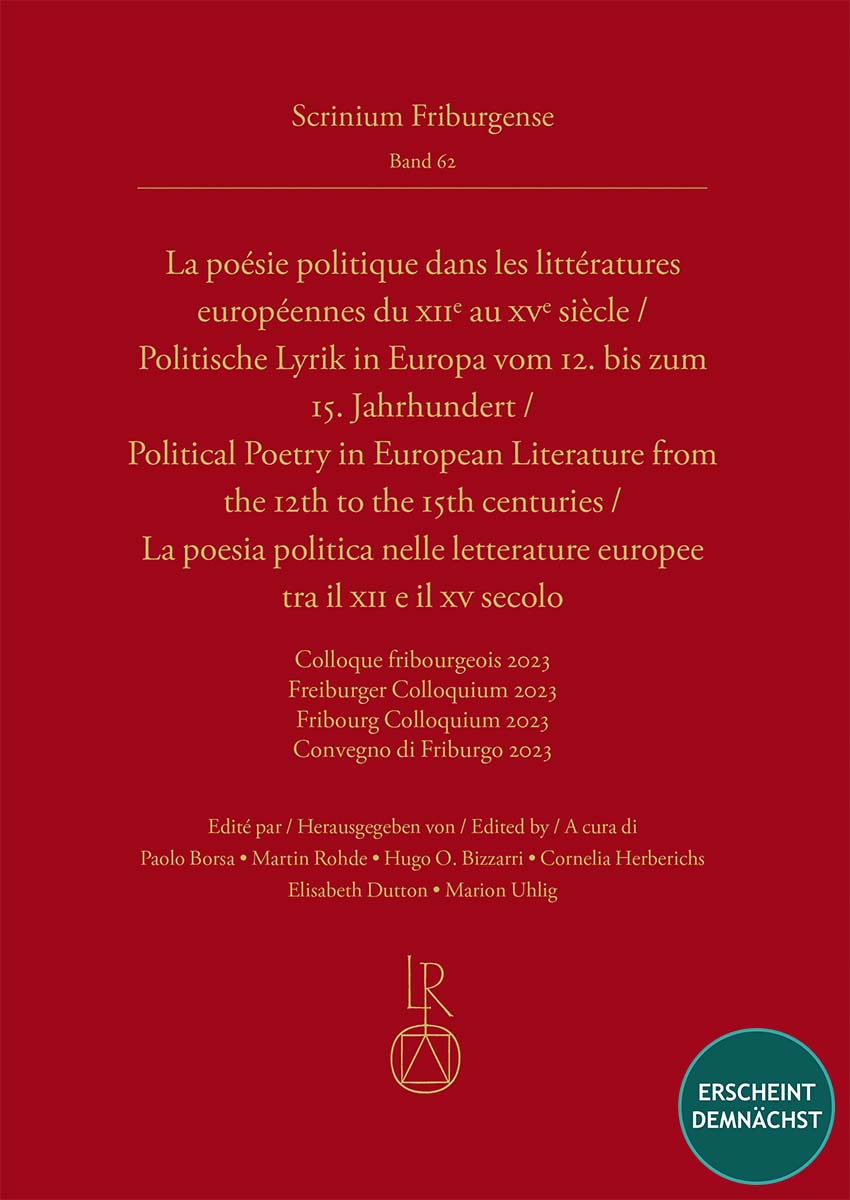
The volume presents the proceedings of the 2023 international conference held in Fribourg (Switzerland), examining the emergence of a European tradition of political lyric between the twelfth-century renaissance and the fall of Constantinople. The essays – written in the four languages featured in the quadrilingual title (French, German, English, and Italian) – adopt a comparative perspective that, ideally, spans from Iceland to the Caucasus. Within this temporal and spatial framework, the volume also explores how political expression in medieval Europe can be studied and understood.
This volume contains the proceedings of the international conference held in Fribourg (Switzerland) in 2023, which addressed the emergence of a European tradition of political poetry between the twelfth and fifteenth centuries. Its chronological scope extends from the so-called twelfth-century renaissance to the fall of Constantinople, while its geographical horizon ranges from Iceland to the Caucasus, within a deliberately comparative framework. Political poetry is here understood as poetic production in which historical contingency and specific circumstances shape both form and meaning. Such texts are typically occasional and event-bound, engaging directly with political contexts and fulfilling pragmatic functions such as exhortation, persuasion, celebration, denunciation, or invective.
The volume adopts a multilingual and comparative perspective. Contributions are written in French, German, English, and Italian, in accordance with the quadrilingual design of the project. This linguistic plurality is methodologically significant insofar as it enables the study of political poetry across distinct literary traditions without reducing them to a unified interpretive model.
The essays collected here address a range of interrelated questions, including the relationship between poetry and historical events, the political potential of language (“politicity”) beyond explicit thematic reference, and the articulation of power, community, and critique through allegorical and formal strategies. Particular attention is also devoted to the circulation and transformation of motifs and poetic techniques across linguistic and cultural boundaries.
By bringing together specialists in medieval European literatures, the volume reconsiders political poetry as a transregional and translinguistic phenomenon embedded in historical contingency. It offers analytical tools for the study of lyric production in relation to political discourse, with special emphasis on the interaction between occasional composition and broader ideological frameworks in medieval Europe. In doing so, the collection contributes to a reassessment of medieval lyric beyond the boundaries of national philologies and discrete literary traditions. It shows how poetic forms operated as instruments of intervention within public and political spheres, while simultaneously participating in the construction of symbolic languages of authority, legitimacy, and conflict. The volume thus provides a framework for further research on political expression in medieval European literature.
Paolo Borsa (* 1975, Milano) is Full Professor of Italian Literature at the University of Fribourg, where he currently serves as President of the Department of Italian. From 2023 to 2025, he was Director of the Medieval Institute of Fribourg. After completing his PhD, he worked as researcher and lecturer at the University of Milan (2010–2019) and also taught at the Polytechnic University of Milan and in the Advanced Master’s Programme in Publishing. He has been Visiting Professor at the Universities of Helsinki and Cambridge, as well as at the Romanisches Seminar of the University of Zurich. He collaborates with the Centre for Medieval Literature (York–Odense) and co-edits the open-access journals Interfaces: A Journal of Medieval European Literatures and Tenzone, together with Rassegna europea di letteratura italiana. His research focuses on early Italian literature, Dante, and eighteenth- and nineteenth-century Italian literature, consistently approached in a broader European context. From 2020 to 2024, he led the SNSF-funded project “Ugo Foscolo, Epistolario 1825–1827”, and he is currently principal investigator of the SNSF project “Poesie e scrittori di poesie: Bologna, 1265–1327”. All his publications are available in open access.
Martin Rohde (*1967 in Berlin), 1992–1999 Studium der Kunstgeschichte, Deutschen Literatur und Hist. Hilfswiss. in Freiburg i. Ü. und Pau (Frankreich). 1999 Lizentiat mit Arbeit über die narrativen Strukturen in der frühgotischen Portalskulptur Frankreichs. 2016 Promotion mit Arbeit über die Theorien und Doktrinen der französischen Denkmalpflege im 19. Jahrhundert. 1997–1999 wissenschaftlicher Mitarbeiter am Centre du Recherche sur le vitrail in Romont. 2000–04 Sekretär und seit Juli 2004 Geschäftsführer des Mediävistischen Instituts.
Die Buchreihe „Scrinium Friburgense“ umfasst Editionen, Monographien und Kolloquiumsbände aus allen Bereichen der Mediävistik, von der Kodikologie, Paläographie und Epigraphik über die mittelalterliche Geschichte, Philosophie- und Kunstgeschichte und die lateinische, deutsche, englische, französische, italienische und spanische Literatur des Mittelalters bis zur Byzantinistik. Besonders willkommen sind Arbeiten interdisziplinären Zuschnitts.
Ce volume contient les résultats du Colloque Fribourgeois 2023, qui s'est penché sur les différentes traditions de la poésie politique dans l'Europe médiévale. La production, la réception et la transmission de la poésie politique y ont été abordées en rassemblant et en confrontant des spécialistes de poésie médiévale issue de différentes traditions linguistiques, dans une région située idéalement entre l’Islande et le Caucase, L'accent est mis sur la période comprise entre le XIIe et la première moitié du XVe siècle.
 Table of Contents