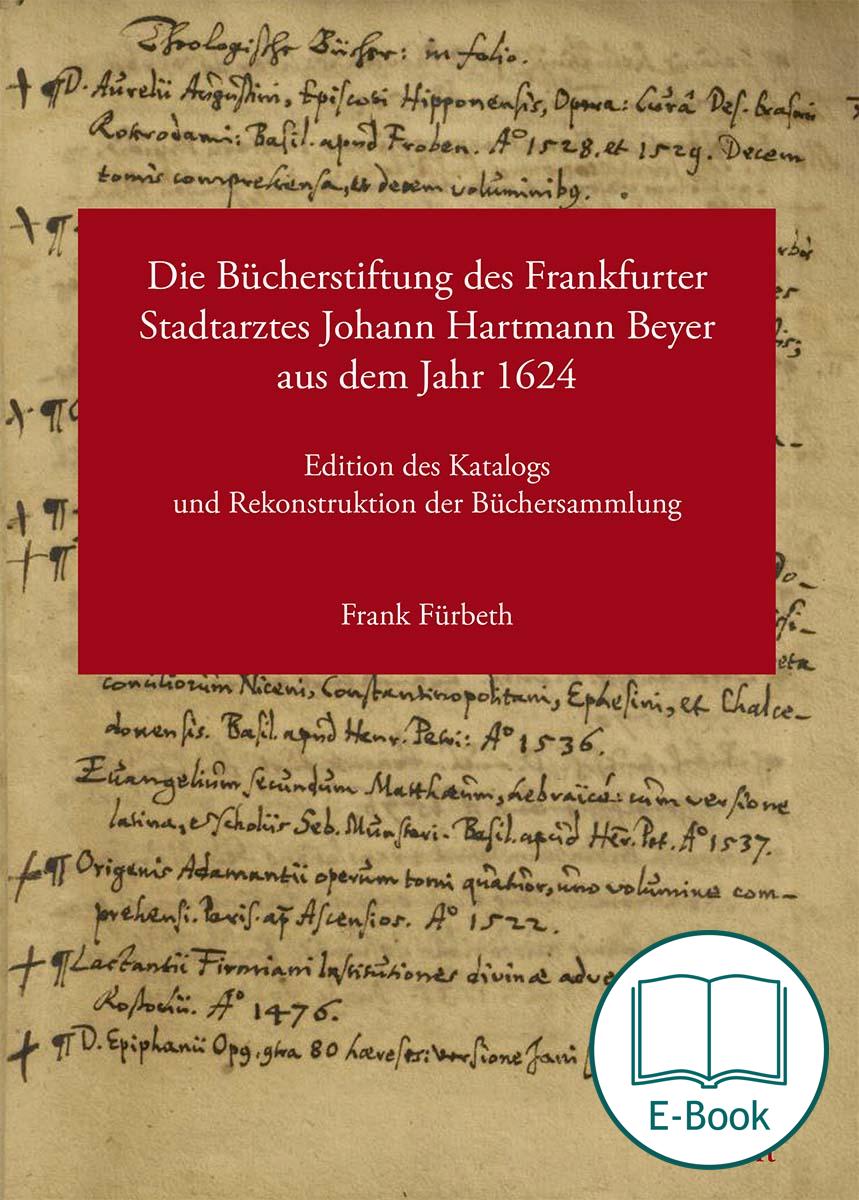
On 13 December 1624, Johann Hartmann Beyer, Frankfurt’s city physician and mathematician, donated his book collection to the city library there. With almost 2,900 printed works and manuscripts in 1,210 volumes, it was the largest private library in the imperial city during the early modern period; it reflects both the political and Reformation debates of the time and the medical and mathematical-astronomical discourses of the 16th and early 17th century. To mark the 400th anniversary of the donation, the inventory of items transferred, compiled by Beyer himself, is being critically edited; together with the approximately 280 surviving volumes in today’s University Library of Frankfurt am Main, this not only enables the reconstruction of the former holdings of the book collection and the chronology of its acquisitions, as well as the role of the Frankfurt book market and Beyer’s academic network.
On 13 December 1624, Johann Hartmann Beyer, Frankfurt’s city physician and mathematician, donated his book collection to the City Library there. Comprising almost 2,900 printed works and manuscripts in 1,210 volumes, it was the largest private library in Frankfurt during the early modern period. The catalogue, which Beyer himself compiled on the occasion of the donation, is still preserved today in the successor institution to the former City Library, the Frankfurt University Library, and is presented here in a critical edition. Together with the 280 volumes from Beyer’s book collection that survived the war and have only recently been rediscovered in the University Library, it is thus possible to reconstruct the library’s holdings and the chronology of its development. Particular attention is paid to the opportunities offered by the Frankfurt book market, whose printers were closely linked to Beyer and his father, the Frankfurt predicant Hartmann Beyer – who had laid the foundations of the future book collection from the 1530s onwards – through their own scholarly work and editorial activities.
In addition, the teachers, fellow students and colleagues of the two Beyers also played a significant role in building up the collection through their inscribed copies. Hartmann Beyer, who had studied the liberal arts and theology in Wittenberg under Martin Luther and Philipp Melanchthon from 1534 to 1546 before taking up the post of preacher in Frankfurt at Luther’s request, had received numerous book donations not only from them, but also from his Frankfurt teachers Wilhelm Nesen and Jacob Micyllus, as well as fellow students such as Adolf von Glauburg, comprising not only Reformation writings but also humanist and mathematical-astronomical works in which Hartmann Beyer took a particular interest. Johann Hartmann Beyer, in turn, who had studied the Artes in Strasbourg and medicine in Tübingen, Padua and Siena from 1579 to 1588, possessed lecture notes from his teachers there, as well as inscribed copies from them and from friends and colleagues, among whom Andreas Libavius is particularly worth mentioning, with whom he shared an interest in alchemical processes. As with his father, however, Beyer’s scholarly passion lay more in mathematics, a field in which he distinguished himself with his own works and corresponded on specific problems with the most eminent mathematicians of the time, including Johannes Kepler. Beyer’s book collection was shaped by the theological and medical professions of the father and son respectively; together, these two fields accounted for around two-thirds of the former collection, with their composition reflecting, on the one hand, the father’s Gnesio-Lutheran standpoint and, on the other, the humanist-influenced medicine and pharmacy of the late 16th century. However, astronomical and mathematical works also accounted for a significant proportion, meaning that the catalogue and the reconstruction of the book collection provide a representative insight into the central discourses and networks of knowledge of the time.
Prof. Dr Frank Fürbeth, born in 1954, studied philosophy and German language and literature in Saarbrücken, Cologne and Frankfurt; held visiting lectureships and temporary professorships in Lublin, Bonn, Leipzig and Essen; joined Goethe University Frankfurt am Main in 2008; retired in 2022. His research and publications focus on the history of private libraries in the late Middle Ages and early modern period, as well as the history of knowledge, particularly in the fields of medicine, military theory, magic and astrology in the Middle Ages
 Sample